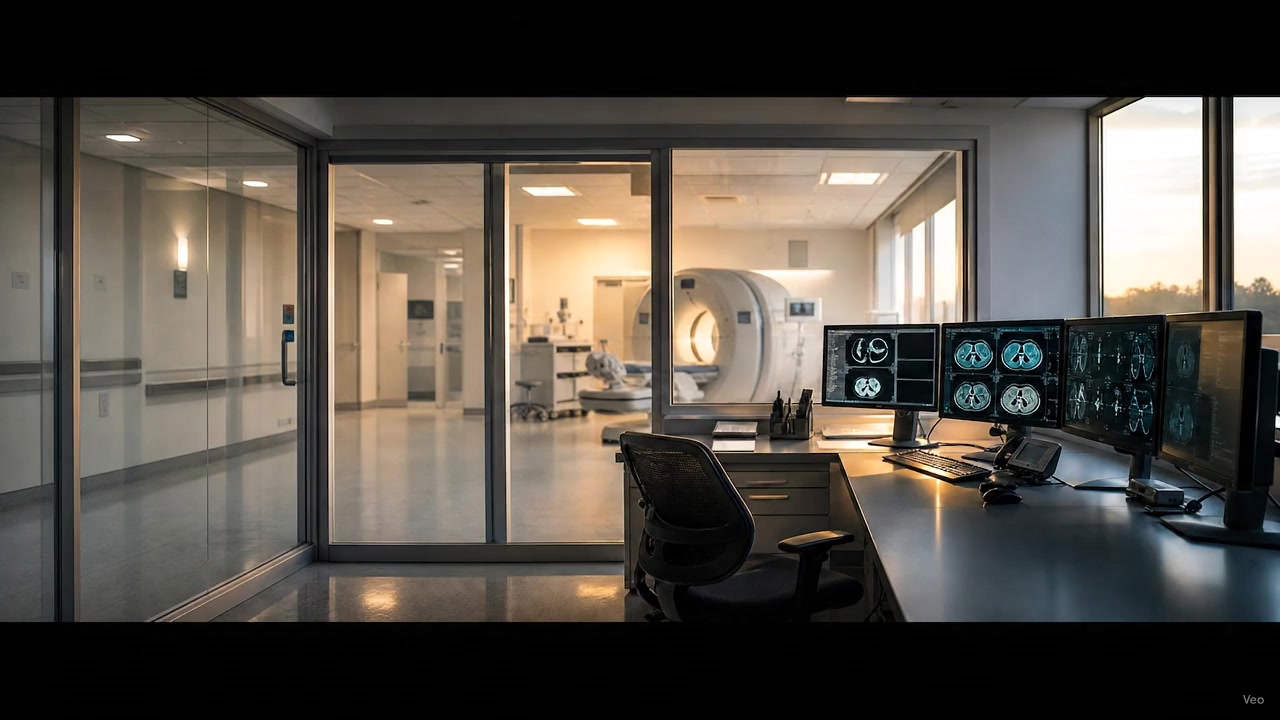
Some rooms stay with us.
02 / Patient threshold
The case enters the procedure.
Symptoms, timeline, prior imaging, pathology, and the clinical question should move into the scanner with the patient instead of arriving later in fragments.03 / Acquisition
The image becomes signal.
As the MRI or CT sequence begins, NEXQ treats the scan as one layer of a larger diagnostic packet, then organizes the signal with patent-pending hybrid-quantum workflow logic.04 / Review layer
Evidence gathers at the workstation.
Algorithmic outputs stay tied to source context, confidence, limitations, molecular signals, and clinician-facing language so precision can be reviewed instead of assumed.05 / Treatment bridge
Diagnosis and planning arrive together.
The review loop connects diagnostic evidence with care-pathway context, contraindications, and variant-informed treatment options to reduce time lost between systems.06 / Patient-owned handoff
The scan travels with the patient.
Integrated PACS access and secure provider communication keep the scan, evidence trail, and next-step plan portable across care teams.01 / Quiet room
The room is quiet before the case arrives.
The first frame is not data. It is a person with work, family, plans, and time that should not be lost while the clinical picture is still scattered.
02 / The clock
The clock begins before the scan.
Cancer volume, aggressive solid tumors, and glioblastoma timelines turn slow diagnosis and fragmented treatment matching into lost choices for patients and care teams.
03 / Acquisition
The image becomes signal.
As the room moves into MRI or CT acquisition, NEXQ's patent-pending hybrid-quantum software keeps symptoms, timeline, prior studies, pathology, molecular context, and the clinical question moving with the scan.
04 / Review layer
The workstation becomes the evidence layer.
Findings are presented with confidence, limitations, source signals, and clinician-facing language so algorithmic precision becomes reviewable evidence, not a black box.
05 / Treatment bridge
Diagnosis and treatment planning arrive together.
The same review loop carries diagnosis-support context, contraindications, molecular signals, pathway context, and treatment-plan options into a secure conversation with the healthcare provider.
06 / Patient-owned handoff
The scan leaves with the patient.
Integrated PACS access and secure provider communication make scans, review context, and next-step plans portable across care teams instead of trapped in one hospital system.
2026 clinical urgencyWhy fast precision matters
~2.1Mnew US cancer cases expected in 2026ACS, 2026
>600KUS cancer deaths expected in 2026ACS, 2026
Accesspatients increasingly expect timely health-information accessONC
Burdenclinician usability and administrative load shape adoptionONC
Patient OSPrivate review loop
Why NEXQ now
Patent-pending hybrid-quantum software for a faster, reviewable path from scan to treatment.
Cancer care is becoming more data-intensive while imaging, pathology, genomics, symptoms, prior notes, and treatment constraints still live across separate systems. NEXQ is building a secure software layer powered by patent-pending hybrid-quantum algorithms so authorized teams can move from scan to diagnosis-support context to treatment-planning review with greater precision, clearer evidence, and less wasted time.
Discuss your workflowA governed software layer for PACS-oriented imaging review, algorithmic prioritization, role-based access, audit posture, and pilot scoping before production deployment.
A hybrid-quantum review packet that keeps scans, symptoms, timeline, molecular signals, source evidence, confidence, limitations, and treatment-pathway context together.
A patient-owned scan and communication path designed to make imaging, next steps, and care-team questions portable across authorized providers.
~2.1Mnew US cancer cases expected in 2026American Cancer Society>600KUS cancer deaths expected in 2026American Cancer SocietyAccesspatients increasingly expect timely access to their health informationONC / HealthIT.govBurdenclinician usability and administrative load remain core adoption barriersONC provider burden
Public marketing describes software direction, patent-pending algorithm posture, and pilot targets. Diagnostic, treatment, speed, precision, and accuracy claims require locked evidence, intended-use review, and applicable clinical/regulatory authorization before production reliance.
System handoff
The room turns into a reviewable system.
The patient context, scan, workstation, algorithmic review, and care question move forward as one packet, then the product architecture opens so clinicians can see exactly what is being reviewed.
03 / System anatomy
The system opens itself for review.
After the patient story and market need, the next scene shows the software infrastructure: devices, data paths, patent-pending hybrid-quantum logic, and review layers separating into parts clinicians can understand.04 / Imaging source
Every scan keeps its origin visible.
NEXQ’s review loop starts with imaging provenance, acquisition context, prior studies, and the clinical question that brought the patient into the room.05 / Evidence packet
Signals become a structured packet.
Hybrid-quantum workflow logic assembles findings, limitations, molecular context, confidence, and source references into a reviewable clinical packet instead of a loose model response.06 / Care bridge
The packet moves toward treatment.
Diagnosis support connects to contraindications, pathway context, variant-informed options, and provider communication inside the same secure workflow so scan-to-treatment planning becomes one governed motion.07 / Patient access
The record becomes portable.
PACS-linked scan access, secure handoff, and patient-owned context help the case travel across clinicians, hospitals, and next-opinion moments.08 / Private pilot
A complex system stays governed.
The exploded view closes as a confidential pilot architecture: reviewable, scoped, evidence-gated, and ready to be evaluated with clinical partners.Scan to plan
One reviewable path from scan to plan.
NEXQ keeps patient context, imaging evidence, molecular signals, and care-pathway decisions together inside patent-pending hybrid-quantum scan-to-plan software, so the next step does not get lost between systems.
Trusted network
Trusted networks keep the work accountable.
NEXQ's trusted network spans oncology, healthcare, academia, federal research, innovation commercialization, compute infrastructure, and cloud systems with a focus on credible relationships, translational momentum, and secure technical execution.